OpenAI Introduces MedChemBench to Test AI in Medicinal Chemistry
OpenAI has introduced MedChemBench, a test comprising 99 tasks to evaluate AI in medicinal chemistry. The results do not prove that models can independently develop drugs.
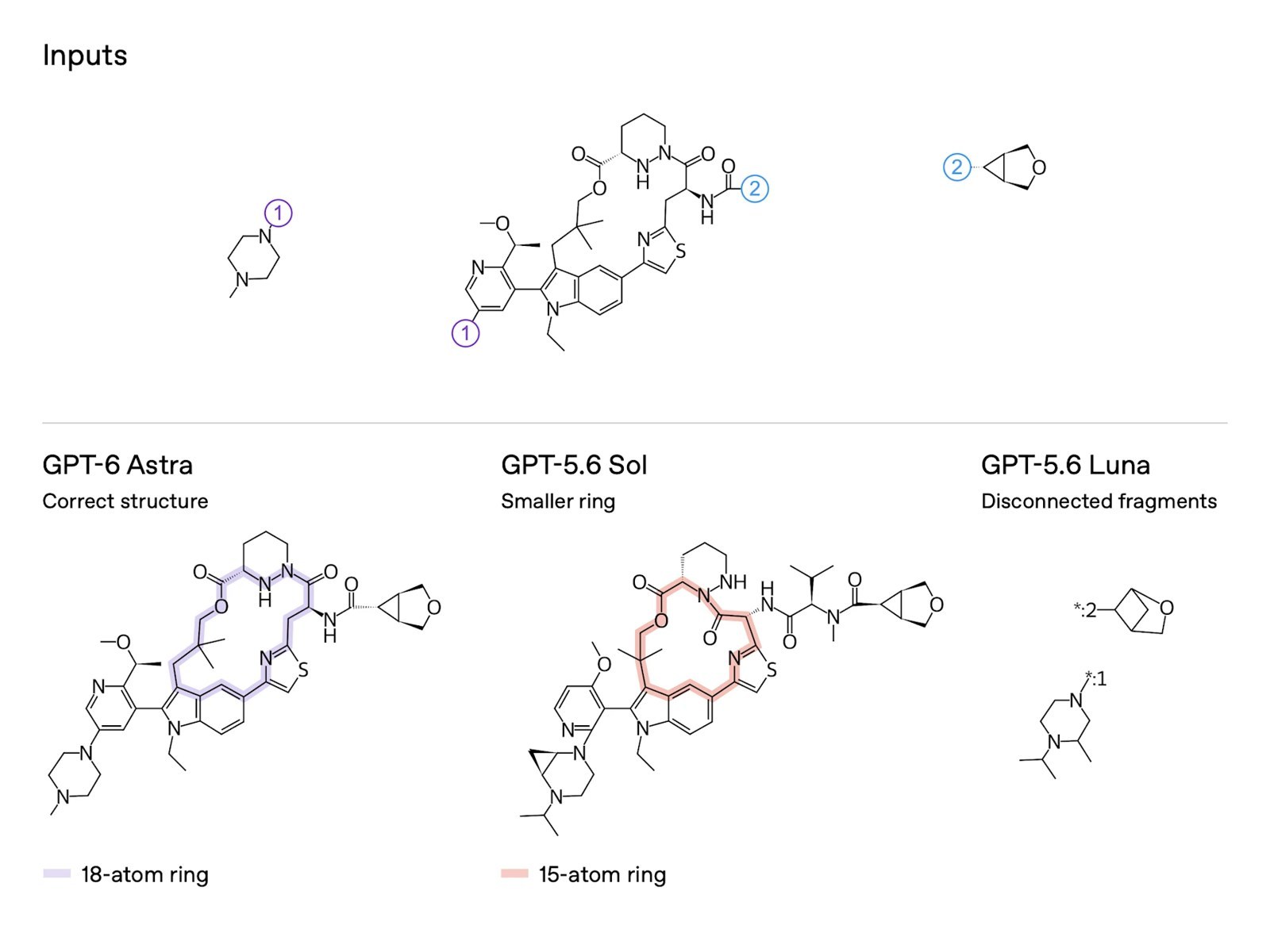
The test is built on data from scientific articles and patents and simulates stages of working with medicinal compounds. Models analyze molecular structures and experimental results, explain conclusions, compare substances, and select options for further study.
MedChemBench evaluates structure recovery, scientific justification of conclusions, ranking of compounds, and prediction of their properties. These characteristics can conflict: a substance may effectively target a protein but poorly penetrate cell membranes or be rapidly degraded by enzymes.
In one of the tasks, models studied inhibitors of the PRMT5 protein. Compound 23 more strongly suppressed its activity, while compound 24 better penetrated the cellular barrier and was more slowly degraded by liver enzymes. In the testing, OpenAI’s GPT-6.2 Astra scored 84.5% of available points, GPT-6 Astra scored 83.3%, GPT-6.1 Sol scored 82%, and GPT-5.6 Sol scored 58.2%.
OpenAI clarified that the models responded without additional tools, feedback, or new experiments, with each given only one attempt. Thus, the test currently demonstrates work with already known scientific data rather than the ability to conduct real drug development.